
Homeowners
How Alcove Works with Property Managers
Cole Nastasi · 3/19/21

Property managers act as the middleman between tenants and landlords for rental properties throughout the country. Common tasks for a property manager include dealing with the property’s turnover to new tenants, marketing and leasing of properties, and any other issues that arise while managing (maintenance, etc.).
In this article we will go over a few reasons why property managers are a key resource in keeping your real estate investment well maintained and cashflow positive. Additionally, we will address how Alcove Rooms fits into this equation.
Disclaimer: Alcove does not operate as a property management firm. Alcove is a technology platform that enables shared housing in any rental property through our operating system, providing the ability to match with roommates and secure leases for those seeking per-bedroom rentals.
1. Listing and marketing properties
Property managers will forge a good working relationship with landlords who use their firm for marketing and managing their real estate. Before advertising their home (which is not occupied by the landlord but rather an investment property in most places), property managers will communicate with their landlord clients and check their requirements for how they'd like to rent out the property. They may ask questions like the following:
Is there a minimum term tenants can rent this property for? (Most landlords say one year, but some may say six months or two years)
Do you allow pets at this property?
Should tenants be non-smokers?
Would you prefer to rent this property to students, young professionals, couples, or families?
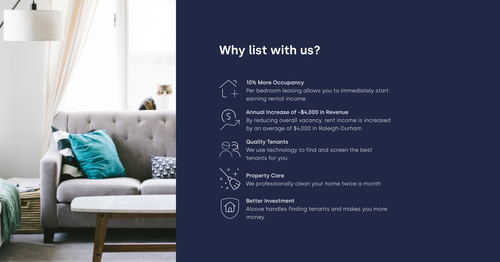
Alcove is a great partner for your real estate investment. With Alcove's marketing engine, landlords and property mangers can see up to 5x the amount of qualified applicants on any given home, due to the nature of shared housing and per-bedroom rentals.
On average, Alcove tenants sign for 12 months and have a 65% renewal rate, thus requiring less turnover and workload for both landlord and property manager.
2. Touring and screening prospective tenants
One of the most important aspects of property management is screening prospective tenants before they move in. Traditionally, property managers have been the first point of contact when tenants get in touch to rent out rooms or the entire property. Managers may take future tenants on viewings or tours around the property and have email correspondence until they sign a lease and move in.
On behalf of the landlord, property managers will perform credit checks and obtain good references for prospective tenants. They will also ensure that the tenant’s salary is enough to cover a month’s rent (sometimes 3x-4x the monthly rent).
Thankfully, Alcove's platform allows prospective applicants to view homes, tour them (virtually or in-person!), and ultimately sign per-bedroom leases on a home.
Alcove's platform is integrated with TransUnion, the industry-leading rental screening solution, and is able to process applicants much faster than other platforms. Their requirements are stringent (either matching or exceeding requirements from property managers), and only the best applicants proceed through the process.
Alcove takes care of all the screening and requirements, and does this at no extra cost to either the property manager or landlord.
3. Day-to-day property management
At the start of a tenant’s stay, the property manager should request them to fill out an inventory. After this has been dealt with, property managers will still be the first contact for any other problems that come up. They could include things like:
Furniture (if it is a furnished apartment) or parts of the home requiring maintenance.
Plumbing problems or issues with the electricity.
Damage caused by a tenant.
The property manager should decide whether the issue was the tenant’s fault or not, and if not, arrange for the repairs to come out of the property budget.
With Alcove's platform, the support team will review any tenant maintenance requests and assist with smaller requests from the tenants as necessary. However, maintenance or property related requests will go to the property manager. This is performed through the Alcove support portal.

4. Leases, deposits, and more
As the property manager, you remain responsible for the home and any required maintenance coordination throughout the tenancy.
Alcove is not a property manager and does not master lease homes. Instead, Alcove provides a platform that helps market the home by-the-bedroom, process rent, support screening, and facilitate lease workflows and communication between residents and the landlord (or the landlord’s property manager).
Through the Alcove platform, residents can submit maintenance tickets, view lease details, and receive automated reminders related to renewals and move-out steps. Final leasing decisions (including approvals, renewals, and lease terminations) are made by the landlord or property manager.
Security deposits are held by the landlord (or property manager, depending on your setup) and are handled in accordance with the lease and local law. Alcove can help facilitate the documentation and workflow for move-out and deposit returns online, but Alcove does not control the final deposit return.

Conclusion
Alcove provides some added upside into the landlord, property manager, and tenant equation. By placing the tasks of listing, marketing, and touring, Alcove is able to effectively and scalably source tenants looking for rooms in homes with our marketing engine and pricing algorithms.
Alcove also takes a lot of pressure off of property management firms by ensuring high standards for screening, property access, and lease inquiries (renewals, terminations, violations, and more).
It is a byproduct of the Alcove platform that enables trust in these relationships, and Alcove is happy to help both property management firms and landlords see more upside - sometimes with 50% more net operating income than traditional renting. Thankfully, all this work is performed for the property management firm and landlord at no extra cost, as our platform fees are charged to tenants or their sponsoring employers.
If you're interested in listing your home on Alcove, start here.
If you want to contact us directly and ask questions, you can text us at (919) 899-4096 or at partner@alcoverooms.com